



![CustomCategorySimpleModel { CustomProperties = System.Collections.Generic.Dictionary`2[System.String,System.String], Id = 7, Name = O-Rings, SeName = o-rings, NumberOfProducts = , IncludeInTopMenu = True, SubCategories = System.Collections.Generic.List`1[Nop.Plugin.Misc.CustomFeatures.Models.Catalog.CustomCategorySimpleModel], HaveSubCategories = True, Route = , DisplayOrder = 1, SubCategory = O-Rings, SubCategorySlug = , SubCategoryImage = PictureModel { CustomProperties = System.Collections.Generic.Dictionary`2[System.String,System.String], Id = 0, ImageUrl = https://callapg.com/images/thumbs/0052611_0047643_o-rings_100.webp, ThumbImageUrl = , FullSizeImageUrl = https://callapg.com/images/thumbs/0052611_0047643_o-rings_100.webp, Title = Show products in category O-Rings, AlternateText = Picture for category O-Rings }, SubCategoryImageId = 52611, InRawMaterials = False, RawMaterialsSubCategory = }](https://callapg.com/images/thumbs/0047643_o-rings.webp)
![CustomCategorySimpleModel { CustomProperties = System.Collections.Generic.Dictionary`2[System.String,System.String], Id = 3, Name = Industrial Couplings, SeName = industrial-couplings, NumberOfProducts = , IncludeInTopMenu = True, SubCategories = System.Collections.Generic.List`1[Nop.Plugin.Misc.CustomFeatures.Models.Catalog.CustomCategorySimpleModel], HaveSubCategories = True, Route = , DisplayOrder = 2, SubCategory = , SubCategorySlug = , SubCategoryImage = PictureModel { CustomProperties = System.Collections.Generic.Dictionary`2[System.String,System.String], Id = 0, ImageUrl = https://callapg.com/images/thumbs/0025611_footer-basic8.png, ThumbImageUrl = , FullSizeImageUrl = https://callapg.com/images/thumbs/0025611_footer-basic8.png, Title = Show products in category Industrial Couplings, AlternateText = Picture for category Industrial Couplings }, SubCategoryImageId = 25611, InRawMaterials = False, RawMaterialsSubCategory = }](https://callapg.com/images/thumbs/0026400_industrial-couplings.webp)

![CustomCategorySimpleModel { CustomProperties = System.Collections.Generic.Dictionary`2[System.String,System.String], Id = 2, Name = Sealing, SeName = sealing, NumberOfProducts = , IncludeInTopMenu = True, SubCategories = System.Collections.Generic.List`1[Nop.Plugin.Misc.CustomFeatures.Models.Catalog.CustomCategorySimpleModel], HaveSubCategories = True, Route = , DisplayOrder = 3, SubCategory = , SubCategorySlug = , SubCategoryImage = PictureModel { CustomProperties = System.Collections.Generic.Dictionary`2[System.String,System.String], Id = 0, ImageUrl = https://callapg.com/images/thumbs/0050071_Sealing.Seals.1.webp, ThumbImageUrl = , FullSizeImageUrl = https://callapg.com/images/thumbs/0050071_Sealing.Seals.1.webp, Title = Show products in category Sealing, AlternateText = Picture for category Sealing }, SubCategoryImageId = 50071, InRawMaterials = False, RawMaterialsSubCategory = }](https://callapg.com/images/thumbs/0026409_sealing.webp)
![CustomCategorySimpleModel { CustomProperties = System.Collections.Generic.Dictionary`2[System.String,System.String], Id = 10, Name = Gaskets, SeName = gaskets, NumberOfProducts = , IncludeInTopMenu = True, SubCategories = System.Collections.Generic.List`1[Nop.Plugin.Misc.CustomFeatures.Models.Catalog.CustomCategorySimpleModel], HaveSubCategories = True, Route = , DisplayOrder = 4, SubCategory = Gaskets, SubCategorySlug = , SubCategoryImage = PictureModel { CustomProperties = System.Collections.Generic.Dictionary`2[System.String,System.String], Id = 0, ImageUrl = https://callapg.com/images/thumbs/0025556_footer-gasket.png, ThumbImageUrl = , FullSizeImageUrl = https://callapg.com/images/thumbs/0025556_footer-gasket.png, Title = Show products in category Gaskets, AlternateText = Picture for category Gaskets }, SubCategoryImageId = 25556, InRawMaterials = False, RawMaterialsSubCategory = }](https://callapg.com/images/thumbs/0026410_gaskets.webp)
![CustomCategorySimpleModel { CustomProperties = System.Collections.Generic.Dictionary`2[System.String,System.String], Id = 4, Name = Industrial Glass, SeName = industrial-glass, NumberOfProducts = , IncludeInTopMenu = True, SubCategories = System.Collections.Generic.List`1[Nop.Plugin.Misc.CustomFeatures.Models.Catalog.CustomCategorySimpleModel], HaveSubCategories = True, Route = , DisplayOrder = 6, SubCategory = , SubCategorySlug = , SubCategoryImage = PictureModel { CustomProperties = System.Collections.Generic.Dictionary`2[System.String,System.String], Id = 0, ImageUrl = https://callapg.com/images/thumbs/0025615_flatfooter.png, ThumbImageUrl = , FullSizeImageUrl = https://callapg.com/images/thumbs/0025615_flatfooter.png, Title = Show products in category Industrial Glass, AlternateText = Picture for category Industrial Glass }, SubCategoryImageId = 25615, InRawMaterials = False, RawMaterialsSubCategory = }](https://callapg.com/images/thumbs/0026412_industrial-glass.webp)
![CustomCategorySimpleModel { CustomProperties = System.Collections.Generic.Dictionary`2[System.String,System.String], Id = 5, Name = Plastics, SeName = plastics, NumberOfProducts = , IncludeInTopMenu = True, SubCategories = System.Collections.Generic.List`1[Nop.Plugin.Misc.CustomFeatures.Models.Catalog.CustomCategorySimpleModel], HaveSubCategories = True, Route = , DisplayOrder = 7, SubCategory = , SubCategorySlug = , SubCategoryImage = PictureModel { CustomProperties = System.Collections.Generic.Dictionary`2[System.String,System.String], Id = 0, ImageUrl = https://callapg.com/images/thumbs/0025639_footer-headgear.png, ThumbImageUrl = , FullSizeImageUrl = https://callapg.com/images/thumbs/0025639_footer-headgear.png, Title = Show products in category Plastics, AlternateText = Picture for category Plastics }, SubCategoryImageId = 25639, InRawMaterials = False, RawMaterialsSubCategory = }](https://callapg.com/images/thumbs/0026406_plastics.webp)


![CustomCategorySimpleModel { CustomProperties = System.Collections.Generic.Dictionary`2[System.String,System.String], Id = 191, Name = Rolls & Sheets, SeName = rolls-sheets, NumberOfProducts = , IncludeInTopMenu = True, SubCategories = System.Collections.Generic.List`1[Nop.Plugin.Misc.CustomFeatures.Models.Catalog.CustomCategorySimpleModel], HaveSubCategories = True, Route = , DisplayOrder = 8, SubCategory = , SubCategorySlug = , SubCategoryImage = PictureModel { CustomProperties = System.Collections.Generic.Dictionary`2[System.String,System.String], Id = 0, ImageUrl = https://callapg.com/images/thumbs/0047674_rolls-sheets.webp, ThumbImageUrl = , FullSizeImageUrl = https://callapg.com/images/thumbs/0047674_rolls-sheets.webp, Title = Show products in category Rolls & Sheets, AlternateText = Picture for category Rolls & Sheets }, SubCategoryImageId = 0, InRawMaterials = False, RawMaterialsSubCategory = }](https://callapg.com/images/thumbs/0047674_rolls-sheets.webp)
![CustomCategorySimpleModel { CustomProperties = System.Collections.Generic.Dictionary`2[System.String,System.String], Id = 215, Name = Tools & Fasteners, SeName = tools-fasteners, NumberOfProducts = , IncludeInTopMenu = True, SubCategories = System.Collections.Generic.List`1[Nop.Plugin.Misc.CustomFeatures.Models.Catalog.CustomCategorySimpleModel], HaveSubCategories = True, Route = , DisplayOrder = 9, SubCategory = , SubCategorySlug = , SubCategoryImage = PictureModel { CustomProperties = System.Collections.Generic.Dictionary`2[System.String,System.String], Id = 0, ImageUrl = https://callapg.com/images/thumbs/0047685_tools-fasteners.webp, ThumbImageUrl = , FullSizeImageUrl = https://callapg.com/images/thumbs/0047685_tools-fasteners.webp, Title = Show products in category Tools & Fasteners, AlternateText = Picture for category Tools & Fasteners }, SubCategoryImageId = 0, InRawMaterials = False, RawMaterialsSubCategory = }](https://callapg.com/images/thumbs/0047685_tools-fasteners.webp)
Updated
Spiral Wound Gasket Color Codes: Decoding the Colors
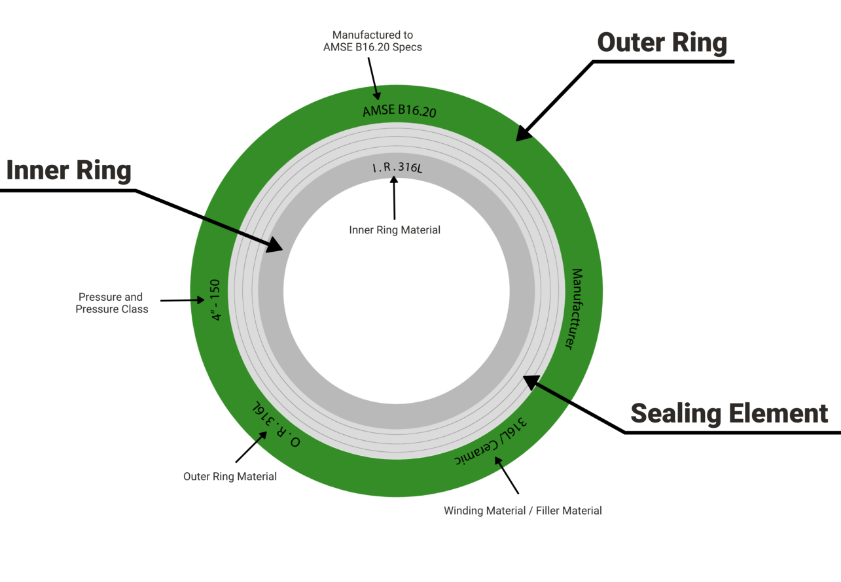
Spiral wound gasket diagram with labels and line pointers indicating the different components of the gasket.
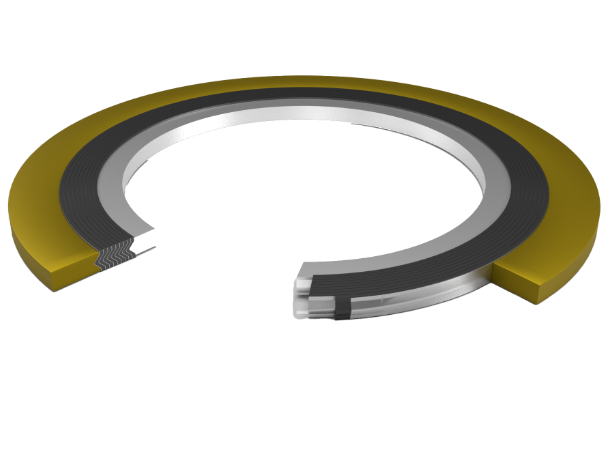
Spiral wound gaskets are a specific gasket design used in high-temperature and high-pressure applications, such as oil and gas operations, refineries, and chemical processing plants. These gaskets are made by winding a metal strip and a filler material, usually graphite or PTFE, in a spiral pattern.
The outer and inner diameters of the gasket may include additional layers of metal and filler material. This design provides a combination of strength, resilience, and the ability to withstand extreme operating conditions.
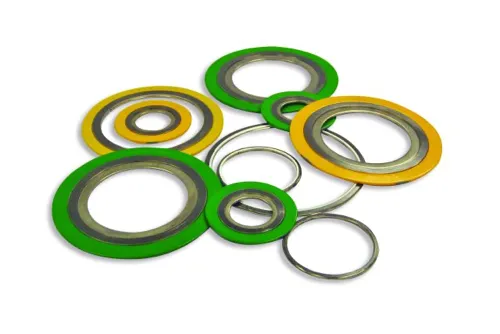
The colors of a spiral wound gasket matter. Industry standards require these gaskets to be color-coded, helping users quickly identify the materials used in the gasket’s construction.
Spiral wound gaskets typically use two distinct color identifiers: the color of the outside rim and the color stripe along the rim. Using the guide below, you can identify common winding materials and filler materials. Those in the oil and gas industry have likely seen gaskets with yellow, green, or orange outside rims, which commonly represent 304 stainless steel, 316 stainless steel, and Monel. The rim stripe is often gray, indicating flexible graphite, a filler used in many different industries and applications.
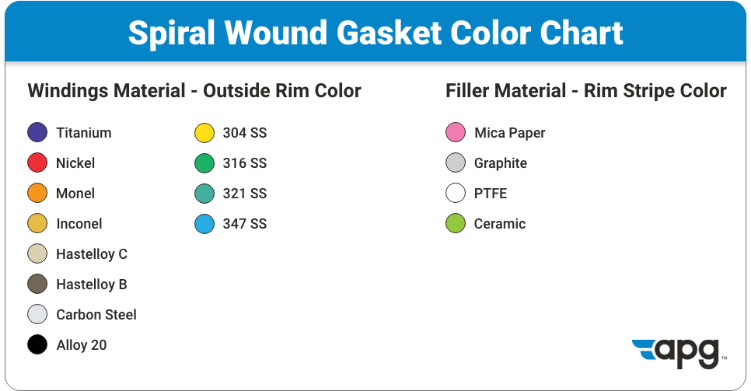
Spiral wound gasket color chart showing common outside rim and stripe color codes.
Outside Rim Color Codes
The outside rim color identifies the gasket winding material. These materials are selected based on temperature, pressure, corrosion resistance, and chemical compatibility requirements.
Titanium
Titanium has excellent corrosion properties in elevated temperatures, oxidant service, nitric acid, and caustic solutions. This material can withstand temperatures up to 2012ºF (1100ºC), with a hardness of 90 HRB. The outside rim color is purple.
Nickel
Nickel has excellent resistance to caustic solutions. This material can withstand temperatures up to 1112ºF (600ºC). The outside rim color is red.
Monel
Monel has excellent resistance to the majority of acids and alkalis, except heavily oxidant acids. This material can withstand temperatures up to 1500ºF (815ºC), with a hardness of 70 HRB. Monel is made up of approximately 67% nickel and 30% copper. The outside rim color is orange.
Inconel
Inconel can withstand temperatures up to 1832ºF (1000ºC). This material has strong corrosion resistance and can withstand pressure up to 5800 psi while under intense heat. The outside rim color is gold.
Hastelloy B
Hastelloy B can withstand temperatures up to 1832ºF (1000ºC). This material has excellent resistance to pitting, corrosion, stress cracking, and thermal instability. However, it can corrode in oxidizing environments. The outside rim color is brown.
Hastelloy C
Hastelloy C can withstand temperatures up to 1832ºF (1000ºC). It is widely regarded as one of the most corrosion-resistant alloys available and is commonly used in chemical processing, petrochemical processing, pulp and paper, and waste equipment applications. The outside rim color is tan.
Carbon Steel
Carbon steel can withstand temperatures up to 932ºF (500ºC). This material is mostly used in manufacturing jacketed gaskets and ring joints. Carbon steel has low corrosion resistance and should not be used in water, diluted acids, or saline solutions. The outside rim color is silver.
Alloy 20
Alloy 20 can withstand temperatures up to 1400ºF (760ºC). This material was specifically developed for applications requiring resistance to sulfuric acid. Alloy 20 has a hardness level of 150 HRB. The outside rim color is black.
304 Stainless Steel
304 stainless steel can withstand temperatures up to 1004ºF (540ºC). This material has a hardness of 68 HRB and is commonly used in industrial gasket manufacturing because of its corrosion resistance, low cost, and availability. It is rated for a maximum temperature of 1004ºF (540ºC), but continuous service temperature is limited to 788ºF (420ºC). This alloy is 18% chromium (Cr) and 8% nickel (Ni). The outside rim color is yellow.
316 Stainless Steel
316 stainless steel is rated for temperatures up to 1472ºF (800ºC). This material has a hardness of 68 HRB and excellent corrosion resistance. This alloy is 18% nickel (Ni), 13% chromium (Cr), and 2% molybdenum (Mo). 316 stainless steel is rated for a maximum temperature of 800ºC, with a continuous service temperature of 760ºC. The outside rim color is light green.
321 Stainless Steel
321 stainless steel is rated for temperatures up to 1598ºF (870ºC). This material has a hardness of 68 HRB, and its chemical makeup helps reduce intergranular precipitation and corrosion. This alloy is made up of 18% chromium (Cr) and 10% nickel (Ni), stabilized with titanium (Ti). The outside rim color is dark green.
347 Stainless Steel
347 stainless steel is rated for temperatures up to 1598ºF (870ºC). This material has a hardness of 68 HRB, and its chemical makeup helps reduce carbide precipitation and intergranular corrosion. This alloy is 18% chromium (Cr) and 8% nickel (Ni), stabilized by columbium/niobium and tantalum. The outside rim color is light blue.
Stripe Color Codes
The stripe color identifies the gasket filler material. Filler materials are chosen based on temperature resistance, chemical compatibility, sealability, and application requirements.
Mica
Mica is rated to withstand temperatures up to 1832ºF (1000ºC). This material is manufactured from mica sheets with an inorganic binder. This filler is resistant to many chemicals, including solvents, acids, caustics, hydrocarbons, and organic products. Mica does not generally offer strong sealability on its own and is often banded with flexible graphite. Together, these materials help deliver flexibility and high-temperature resistance. The stripe color is pink.
Ceramic
Ceramic is rated for temperatures up to 1994ºF (1090ºC). This filler is used in high-temperature applications. The stripe color is lime green.
PTFE (Polytetrafluoroethylene)
PTFE is rated for temperatures up to 500ºF (260ºC). This filler should be confined in a grooved flange or used with an inner ring to improve durability and avoid buckling. The stripe color is white.
Flexible Graphite
Flexible graphite is rated for temperatures up to 842ºF (450ºC). This filler is used mainly in refineries, chemical processing, petrochemical, and pulp and paper industries. Flexible graphite is known to have “fire-safe” properties and is commonly used with flammable products such as fuels and hydrocarbons. The stripe color is gray.
APG Wants to Be Your Gasket Supplier
Gaskets come in many shapes, sizes, and materials, and you may not be sure where to start when shopping for the products you need. APG can help. Since 1943, we have provided customers with high-quality sealing products and technical support to help them choose the right product and material for their application.
Shop our gasket selection, contact us with questions, or visit our knowledge base to learn more.
We look forward to exceeding your expectations in both quality and service.